| Wahoo's
Loss: A Report from Japan
by
Bryan Mackinnon
On
November 16, 2000, I joined four Japanese veterans for a 3 hour Wahoo
lunch. Each year, these WWII midget submarine veterans meet in Tokyo
in a kind of informal reunion. Far from merely dwelling on their own exploits,
the Wahoo has become sort of a quest for them. Joining me were Kayoko
Itoh and Keiko Takada who both work for me at Merrill Lynch in Tokyo and
have been invaluable assistance in the ongoing Wahoo research.
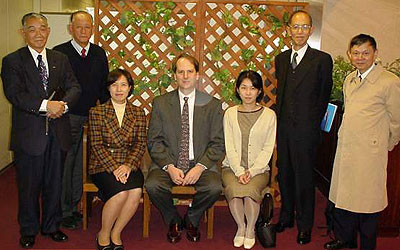
Participants
L-R: Saga, Tamagawa, Takada, MacKinnon, Itoh, Ueda, Kitazawa.
Kazuo
Ueda: Captain, JMSDF Navy Retired; If there is one person who is responsible
more than any other of what we know of the Wahoo's fate, it is Ueda-san.
He has devoted many years of research into the Japanese archives.
During the closing days of WWII, he was a crewman aboard a 5 man midget
submarine.
Satoru
Saga: Captain, JMSDF Navy Retired; Along with Ueda-san, has contributed
significantly to the knowledge that we currently have about the Wahoo's
final battle. A resident of Wakkanai, Hokkaido for many decades, Saga-san
knows personally many of the people who participated in the attack on the
Wahoo. He was the key person from the Japanese side for construction
of the Wahoo memorial in Wakkanai. Along with Ueda-san, he
was aboard a midget submarine during the war.
Yasuhiro
"Tommy" Tamagawa: Captain, JMSDF Navy Retired. Fluent in English,
Tamagawa-san
has been a liaison between the Japanese and American navies
since
the early 1950's when he was part of a officer exchange program and was
assigned to Quantico Marine base. Today he is a manager at Lockheed Martin.
Tamagawa-san was Master of Ceremonies at the Wahoo Peace Memorial
dedication in 1995. Like Ueda-san and Saga-san, Tamagawa was aboard a midget
submarine during the war. He describes their assignment has a kind of suicide
mission. They were stationed in Japan inland sea to fend off the anticipated
American invasion in 1945. Fortunately for us all, the invasion never came.
Noritaka
Kitazawa: Captain, JMSDF Navy Retired: Junior to the other three and not
active during WWII, he now works at the Japan National Institute for Defense
Studies. Kitazawa-san has been extremely helpful during the Wahoo
research including assistance in finding the long lost final battle photos.
Keiko
Takada: Works at Merrill Lynch Japan. Takada-san has a law degree and
is
an experienced researcher in Government archives. Working with
Kitazawa-san,
Takada-san uncovered many documents including the two
photographs
of the Wahoo under attack.
Kayoko
Itoh: Also works at Merrill Lynch Japan. Kayoko is fluent in both
Japanese
and English and has been very helpful during translations and
interpretation.
The
discussions ran as follows:
SOYA
STRAIT
*
Visibility is approx. 10 meters depth from the surface. Sea floor depth
is approx. 60 meters.
*
The current is swift and varies from 1 to 1.5 Knots. The combination of
tides, current, and the intersection of warm waters from the Japan sea
and cold waters from the North Pacific makes for often turbulent seas and
poor atmospheric conditions.
THE
BATTLE
*
Ueda-san believes the claim of the Imperial Japanese Army (IJA) firing
upon a surfaced Wahoo is bogus. At the closest approach, the
Wahoo was 12 nautical miles from nearest shore and would be extremely
difficult, if not impossible, to see. He has a healthy contempt of
IJA capabilities and feels they made the claim sometime after the battle
simply to share in the glory.
*
More likely, the Japanese were just on the alert and happened to see a
small oil slick coming from a propeller shaft. Such slicks are common
enough and the Wahoo was cursed by uncommonly fair weather.
*
The Wahoo was under water and close to the surface, probably to
avoid the suspected mines.
FINDING
THE WRECK
*
The site of the Wahoo is thought to be one of two places. Either
the site of the battle or a location about 10 miles east where fishermen
often caught their nets (to the point they don't go there much any more).
*
Within Russian waters in either case.
*
Getting permission from the Russians is important. The Japanese coast guard
would be responsible for any mishaps otherwise.
*
The idea of just dropping a camera down in at the two locations was discussed
as was use of Sonar and even ASW airplanes. Ultimately, the discussion
would flow back to Russian permission.
*
I suggested I could write a letter the Russian embassy in Tokyo. Tamagawa-san
suggested addressing it to the Naval Attaché.
*
A Russian sub is believed to have been sunk in the region during the
closing
days of the war, possibly after hitting a mine. This sub left port,
attacked
a Japanese ship, then disappeared. It's location is unknown.
DOCUMENTS
*
We exchanged documents and photographs. I was presented with a
comprehensive
set of documents from Saga-san including the map with the
latest
known locations pinpointed. With this and what I had before, I think
I
just have about all documents that are available in Japan.
THE
PEACE MEMORIAL
*
The Wahoo Peace Memorial is in good shape. Some minor repairs
have
been
made and the city of Wakkanai is taking it over. Expected maintenance
is
low.
Bryan
MacKinnon resides in Tokyo, Japan, hosts his own Wahoo website, and is
the grand nephew of Dudley W. Morton. Contact him via: bryan@mackinnon.org.
|